← Issue 1 · December 2026 contents
LEAD FEATURE · BE LEGAL IN WA
Register first, list second: your WA compliance guide
Last reviewed: 17 November 2026
Western Australia now fines hosts who get the basics wrong. This is the full, practical guide to being legal today: who registers, what it costs, where your number goes, how the 90-night exemption really works, and what ends a registration.

- What changed
- the state has moved to enforcement, issuing its first fine in August 2026.
- Who it affects
- every hosted and unhosted STRA provider in WA, including tenants and strata owners.
- What to do
- register, display your number in every advertisement, and stay inside your planning limits.
The fine that made it real
In August 2026 a provider letting a home in the Perth metropolitan area became the first to receive an infringement under Western Australia's short-stay laws. The amount was A$2,000. The allegation was not about noise, parties or tax. It was that the advertisement did not show a registration number (the case is on page 22). Announcing it, the Commissioner for Consumer Protection, Trish Blake, put it plainly: "Displaying a registration number is not optional."
A missing number is easy to fix. Planning approval, strata restrictions and rental permissions can take considerably longer. The safest approach is to work through the requirements in order, starting with registration and ending with the conditions specific to your property.

Who has to register
Registration has been mandatory for all short-term rental accommodation in WA since 1 January 2025. It does not matter whether you let the whole house or a single room, whether you use Airbnb or take direct bookings, or whether you own or rent. Registration generally applies to residential premises offered to paying guests for short stays; the register's guidance describes premises rented out "for periods of less than 3 months". Some accommodation categories are treated differently, so check the official definition if your property or bookings are unusual.
The law splits stays into two kinds. Hosted means the host lives on the property during the stay. Unhosted means guests have exclusive use of the whole dwelling. Both must register. The difference matters for planning, not for registration.
Tenants can be caught too. If you rent your home and want to let it short-term, the register's guidance is cautious but clear: it is allowed only "If you are a Tenant in a property and your Residential Tenancy agreement does not prohibit STRA," and it recommends you "discuss the sub-letting arrangement with your landlord or property manager." You would still have to register the premises yourself.
Granny flats follow the same logic. A granny flat can be hosted where the host lives in the main house, and the reverse also works: the host lives in the granny flat and lets the main house. If both dwellings on a lot are let, they are treated as unhosted and each must be registered separately.
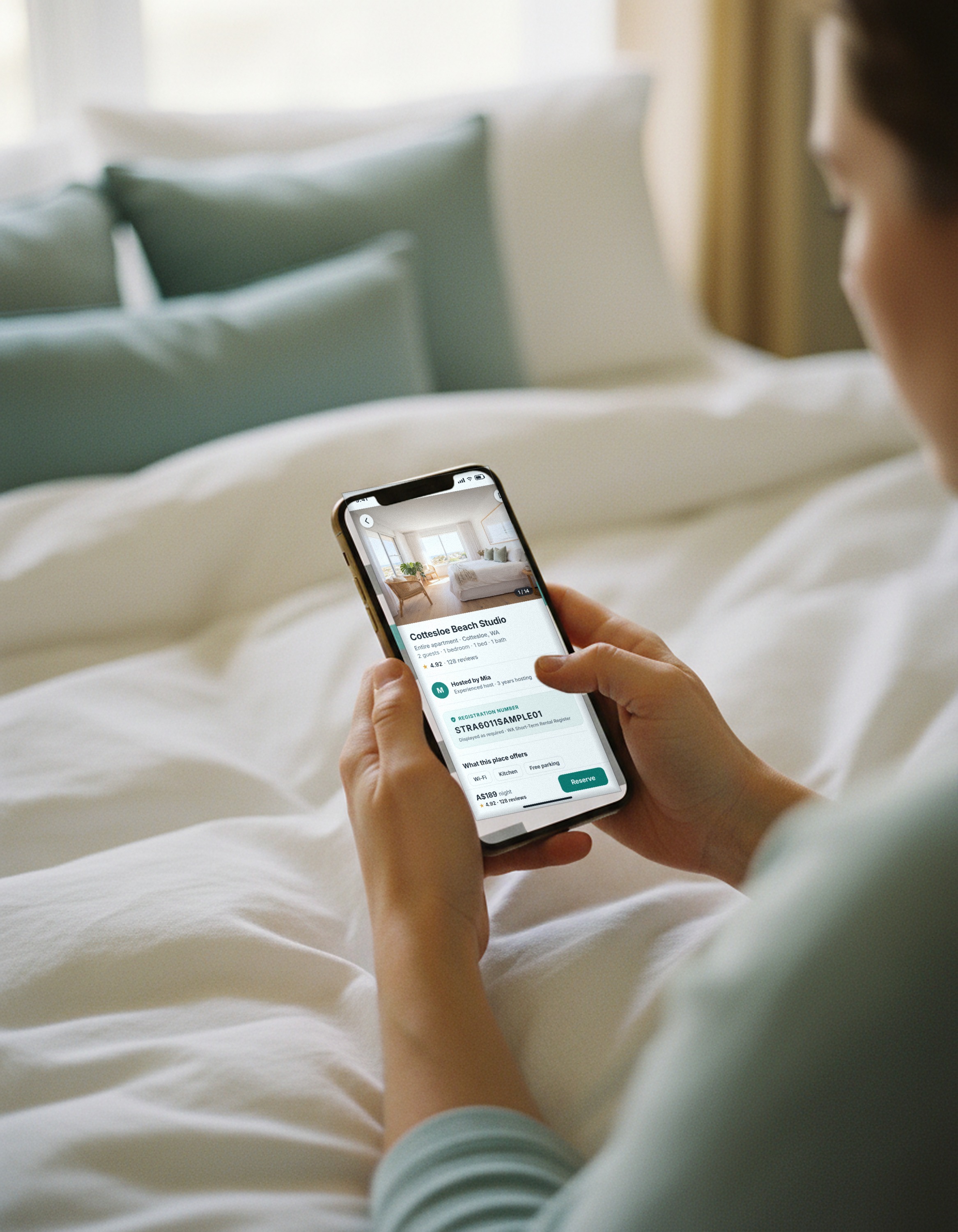
How to register, and what it costs
You register through the WA Government's STRA Register, which runs on a MyAccount login, as either an individual user or a business user if you register on someone else's behalf. You provide the property details the Act requires, confirm whether the accommodation is hosted or unhosted, and pay the fee. As part of registration, demonstration of planning approval may be required, so have your planning position clear before you start. The initial fee is A$250. Registration then has to be renewed every year, and the renewal fee is A$100. The official fees page does not state whether these amounts include GST, so treat the GST status as not stated and keep your receipt.
If an agent handles your property, they can finish the job for you, but you have to start it: the register's FAQ says "the owner or tenant must commence the registration", entering the property's name and address and assigning the management company, which then completes it on your behalf. When you register you receive a registration number. That number is the single most important output of the whole process, because it is what every advertisement must carry.
Where your number must appear
The rule is specific. The register's advertising guidance says the number "must be displayed in a conspicuous (readily visible) manner on the advertisement for the STRA premises," and that it must be the correct number for that property. "Penalties apply for prohibited advertisements that do not meet the above criteria."
In practice, that means the number goes on every surface where the property is offered: your Airbnb and Booking.com and Stayz listings, your own website, and any Facebook or Instagram post that advertises availability. Platforms are also now prohibited from publishing advertisements for unregistered properties, so an incomplete entry can see a listing pulled, not just fined. Put the number in the listing description where a reader and an inspector can both see it, and check it after every platform redesign.
The 90-night exemption, counted properly
This is where good hosts still trip. Within the Perth metropolitan area, an unhosted property does not need development approval if it "is leased for 90 nights or less (non-consecutive) within a 12-month period, as per the date of registration." Outside the Perth metropolitan area, each local government decides whether unhosted stays need development approval from the first night. Hosted stays need no planning approval anywhere in WA.
Three details decide whether you stay inside the exemption. First, the clock starts at your registration date, not the calendar year. Second, only nights actually let to guests count: the Register "will capture the number of nights a registered premises is booked," and "Periods when the property is blocked out by an owner for private use are not counted towards nights booked." Your own stays and owner-blocked dates are free. Third, the 90 nights are cumulative across the year, not a single block, so a steady drip of weekends adds up as surely as a long summer let.
The Register does some of the watching for you. It pulls booking data automatically from platforms such as Airbnb, Stayz and Booking.com, asks you to enter direct bookings manually, and will "send reminders for applicable premises when you reach 80 and 90 nights booked." Treat the 80-night reminder as your cue to decide what you are doing for the rest of the year.
When you cross 90 nights
If you plan to let an unhosted Perth property for more than 90 nights, the planning advice is to seek development approval "from the outset prior to taking bookings". Do not wait for the 80-night reminder before starting the application. Approval is granted by your local government, and timeframes and conditions vary between councils, so build in weeks, not days. Some councils tie an approval to the current owner and to a management plan, and may limit it to a period of review.
There is also a requirement that took effect in January. Since 1 January 2026, registered properties must be able to demonstrate they meet development-approval requirements to remain registered. If your nights have crept up without approval, that is the gap to close.
When a stay runs long
A booking longer than three months may fall outside the usual STRA arrangements, but its length alone does not decide whether residential tenancy law applies. The register notes such a stay may come under the Residential Tenancies Act 1987 (WA) if it is not for a holiday, so the nature and purpose of the stay matter. If you take extended bookings, check your legal position before making commitments about bonds, access or ending the stay.
Strata, suspension, and the things that end a registration
If your property sits in a strata or community-title scheme, you can operate STRA "unless a by-law prohibits STRA." Where a by-law does prohibit it, running one anyway puts your registration at risk: you "may risk cancellation or suspension of your registration by contravening this by-law." Read your scheme's by-laws before you list, not after a complaint.
Registration is not a one-off badge. It can be suspended or cancelled, and it expires 12 months after it is completed; the register sends reminders before then, but if you do not renew it lapses, and an unregistered property cannot lawfully advertise or take bookings. Certain offences carry maximum court-imposed fines of A$20,000 for an individual and A$100,000 for a corporation.
Check before you trust
Finally, use the public STRA registration check on wa.gov.au to confirm whether a property is registered and whether its number is valid. Run your own address through it after you register and after any platform redesign, and use it on any property you are about to co-host, manage or buy. It is a useful first check, not proof of full legal compliance: planning approval, strata restrictions and other permissions still need checking separately.
Registration is the starting point, not the finish line. The strongest routine checks your registration, your advertising, your planning position, your property permissions and your renewal date together, once a quarter and before every peak season.
"Displaying a registration number is not optional."Trish Blake, Commissioner for Consumer Protection.
What this means for WA hosts
Bottom line: registration is the starting point; check advertising, planning, property permissions and renewal together.
Who it applies to: every host, owner, co-host, tenant-operator and property manager running STRA in WA.
Actions:
- Register the property and keep the registration current.
- Display the correct registration number in every advertisement, on every platform.
- Count let nights from your registration date and watch the 80-night reminder.
- Seek development approval before taking bookings beyond 90 unhosted nights in Perth metro.
- Check by-laws, your lease, and the public register before you list.
Deadline: before your next booking is accepted.
Cost: A$250 to register, A$100 a year to renew (GST not stated); development-approval fees are set by your council.
General information only, current to 17 November 2026. Not legal, tax or financial advice.
Get Western Host free every month
One issue a month, by email. Unsubscribe any time.